
Article Overview
What Is Projector Brightness?What Are ANSI Lumens? What Are ISO Lumens? ANSI Lumens vs. ISO Lumens Is ISO Lumens Really 20% Lower Than ANSI Lumens?Beyond ANSI and ISO: What Actually Affects Image Quality?How Many Lumens Do You Need?FAQPrime Day Special
Ends at July 18

Aurora Pro MKII
Next-Level 4K Tri-Color Laser Projector
$2699 $3499
ANSI Lumens vs. ISO Lumens: What's the Real Difference?
NexiGo | Jul 16, 2026
When comparing projectors, you've probably noticed that some models are rated in ANSI Lumens, while others use ISO Lumens.
This often leads to questions like:
- Is ANSI brighter than ISO?
- Can I compare ANSI Lumens with ISO Lumens?
- Are ISO Lumens really 20% lower?
The short answer is yes, you can generally compare them, and no, ISO Lumens are not automatically 20% lower than ANSI Lumens.
In reality, ANSI Lumens and ISO Lumens are different standards, but they measure projector brightness in nearly the same way. The biggest differences lie in the standards behind the measurements, not in the brightness you actually see on screen.
This guide explains what ANSI Lumens and ISO Lumens are, how they differ, where the "20% myth" came from, and what you should really look for when choosing a projector.
Quick Answer
If you're short on time, here's the key takeaway:
ANSI Lumens and ISO Lumens both measure the brightness projected onto a screen using standardized testing methods. For most consumers, the results can be compared directly.
Here's what you need to know:
- ✅ Both are recognized industry standards.
- ✅ Both measure projected screen brightness, not the light output of the lamp or laser itself.
- ✅ Both use a multi-point measurement across the projected image.
- ❌ There is no official ANSI-to-ISO conversion formula.
- ❌ The widely shared "ANSI × 0.8 = ISO" rule is not part of either standard.
If two projectors are rated using ANSI Lumens or ISO Lumens from reputable manufacturers, the brightness figures are generally comparable.
What Is Projector Brightness?
Projector brightness describes how much visible light reaches the projection screen. It's measured in lumens, the standard unit used to quantify light output.
Brightness plays a major role in determining how well a projected image holds up under different lighting conditions.
In general:
- More lumens produce a brighter image.
- Fewer lumens work well in dark rooms.
- The ideal brightness depends on your room lighting, screen size, and viewing habits.
For example, a projector with around 1,200 lumens may look excellent in a dedicated home theater, while a bright living room may require 2,500 lumens or more to maintain a vivid image.
Because brightness is one of the most important projector specifications, manufacturers need a consistent way to measure it. That's where ANSI Lumens and ISO Lumens come in.
What Are ANSI Lumens?
ANSI Lumens are a standardized measurement of projector brightness defined by the American National Standards Institute (ANSI).
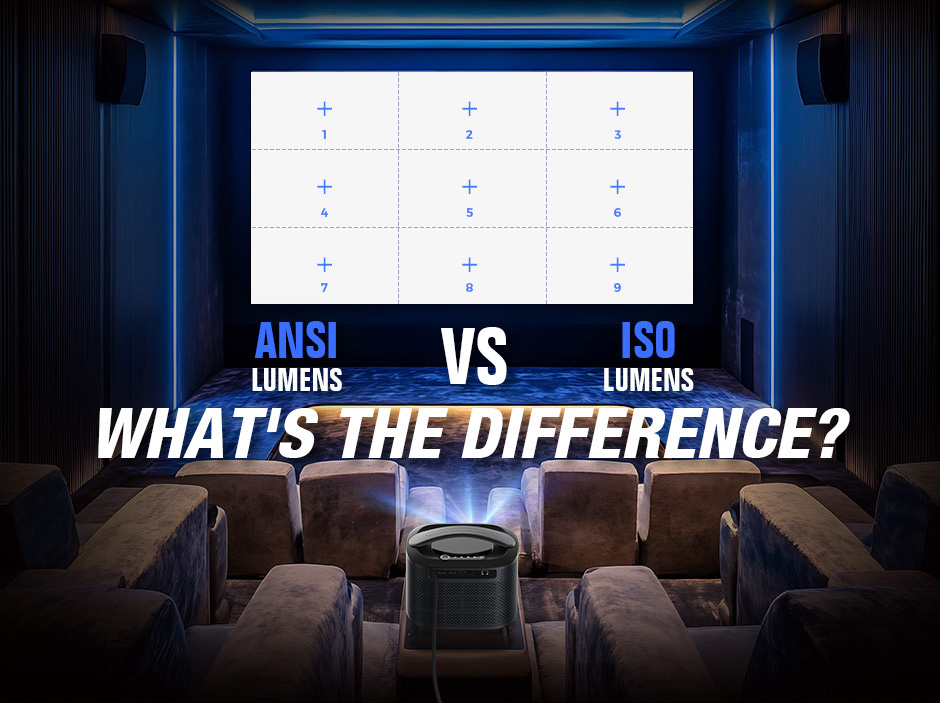
Instead of measuring only the brightest spot on the screen, ANSI evaluates the brightness of the entire projected image.
The measurement process is straightforward:
- A full-white test image is projected.
- The image is divided into a 3 × 3 grid.
- Brightness is measured at nine evenly distributed points.
- The nine readings are averaged to calculate the projector's brightness.
Rather than emphasizing peak brightness at a single location, the ANSI method reflects the average brightness users are more likely to experience during normal viewing.
What Are ISO Lumens?
ISO Lumens are defined by ISO 21118, the international standard for measuring projector brightness.
Like ANSI Lumens, ISO measures the brightness of a projected full-white image using a standardized multi-point method. The core measurement principles are nearly identical, which is why ANSI and ISO brightness ratings are generally comparable in real-world use.
However, ISO isn't simply "ANSI with a different name”.
Unlike ANSI, ISO 21118 goes beyond the measurement procedure itself. It also defines how brightness specifications should be declared and establishes additional requirements to improve consistency across mass-produced products and international markets.
Key differences include:
Production Consistency
ISO specifies that published brightness should represent the performance of production units rather than a specially selected sample.
It also requires manufacturers to ensure that production units do not fall below 80% of the published brightness specification, helping improve consistency across mass-produced products.
This production requirement is one of the main reasons many people mistakenly believe ISO Lumens are always "20% lower" than ANSI Lumens.
Standardized Test Conditions
ISO provides detailed guidance for testing conditions (including input voltage, room temperature, and ambient lighting) to improve consistency between laboratories and manufacturers around the world.
Global Adoption
Because ISO is an internationally recognized standard, it provides a unified framework that manufacturers can use across different countries and regions.
As a result, many projector brands have gradually transitioned from ANSI Lumens to ISO Lumens for new product launches.
For consumers, however, the takeaway is simple:
ISO Lumens measure projector brightness in nearly the same way as ANSI Lumens. The additional ISO requirements are primarily about standardization and production consistency, not making projectors appear brighter or dimmer.
ANSI Lumens vs. ISO Lumens
Although ANSI Lumens and ISO Lumens are different standards, they are designed to answer the same question:
How bright is the projector on the screen?
The biggest differences lie in who defines the standard and what else the standard covers, rather than in how brightness itself is measured.
| Category | ANSI Lumens | ISO Lumens |
|---|---|---|
| Standards Organization | American National Standards Institute | International Organization for Standardization |
| Primary Standard | ANSI IT7.215 | ISO 21118 |
| Brightness Measurement | Average of 9 points across a projected white image | Average of 9 points across a projected white image |
| Primary Focus | Standardized brightness measurement | Standardized brightness measurement + production consistency + international testing requirements |
| Production Consistency Requirements | Not explicitly defined | Defined under ISO 21118 |
| Typical Usage | Long-established industry standard | Increasingly adopted by global projector manufacturers |
What's the Real Difference?
From a buyer's perspective, very little.
ANSI focuses primarily on how brightness is measured, while ISO builds on a similar measurement method with additional requirements for production consistency and international standardization.
That's why more manufacturers are switching to ISO: not because ISO measures brightness differently, but because it provides a single globally recognized standard for products sold around the world.
For projector buyers, the important question isn't whether the specification says ANSI or ISO.
It's whether the brightness has been measured using a recognized, standardized method.
Is ISO Lumens Really 20% Lower Than ANSI Lumens?
One of the most common claims you'll find online is that ISO Lumens are about 20% lower than ANSI Lumens.
You may have seen formulas like:
ANSI Lumens × 0.8 = ISO Lumens
or
ISO Lumens × 1.25 = ANSI Lumens
- Precise brightness control
- Dynamic contrast optimization
- Accurate, true-to-life color reproduction
These formulas appear on forums, YouTube videos, and even some retailer websites.
But they are not official conversion formulas. Neither ANSI nor ISO defines a mathematical relationship between the two standards. So where did this idea come from?
Where Did the "20% Rule" Come From?
The confusion stems from one important feature of ISO 21118.
Unlike ANSI, ISO doesn't only define how projector brightness is measured. It also specifies how manufacturers should declare brightness for production units.
ISO requires that the published brightness represents the performance of production units, and shipped products should not fall below 80% of the published specification.
Over time, this production consistency requirement was mistakenly interpreted as a conversion between ANSI and ISO measurements.
In reality, the 80% requirement is a manufacturing tolerance, not a brightness conversion factor.
It was never intended to mean that ISO Lumens are always 20% lower than ANSI Lumens.
What Do Independent Tests Show?
Official standards explain how brightness should be measured.
Independent reviewers show what actually happens in the real world.
One of the most comprehensive comparisons comes from The Hook Up, which has tested dozens of projectors using the same equipment, the same screen, and the same testing procedure.

(Measured Brightness Results for Long-Throw Projectors, Source: The Hook Up)

(Measured Brightness Results for Ultra Short Throw Projectors, Source: The Hook Up)
The results are surprisingly consistent:
- Some ISO-rated projectors measure higher than their published specifications.
- Some ANSI-rated projectors also exceed their advertised brightness.
- Others measure slightly below their specifications.
There is no consistent 20% gap between ANSI-rated and ISO-rated projectors.
Instead, the variation between individual projector models is often greater than any theoretical difference between ANSI and ISO measurements.
This suggests that factors such as optical design, picture mode, factory calibration, and manufacturing tolerances have a much larger impact on measured brightness than the standard itself.
Another respected publication, Projector Reviews, reaches a similar conclusion. Their analysis notes that modern ANSI and ISO measurements are generally comparable in practice, while proprietary terms such as LED Lumens, Light Source Lumens, or Peak Lumens should not be compared directly with either standard.
The Bottom Line
For consumers, the evidence is clear:
- There is no official ANSI-to-ISO conversion formula.
- Independent testing does not show a consistent 20% difference.
- ANSI and ISO ratings can generally be compared directly when measured according to their respective standards.
Beyond ANSI and ISO: What Actually Affects Image Quality?
Once you've confirmed that a projector uses ANSI Lumens or ISO Lumens, there are several factors that have a much greater impact on your viewing experience. To get a complete picture of what to look for beyond just brightness, check out our ultimate walkthrough, How to Choose the Best Home Theater Projector: A Complete Guide 2026, where we break down everything from contrast ratios to throw distances.
Contrast
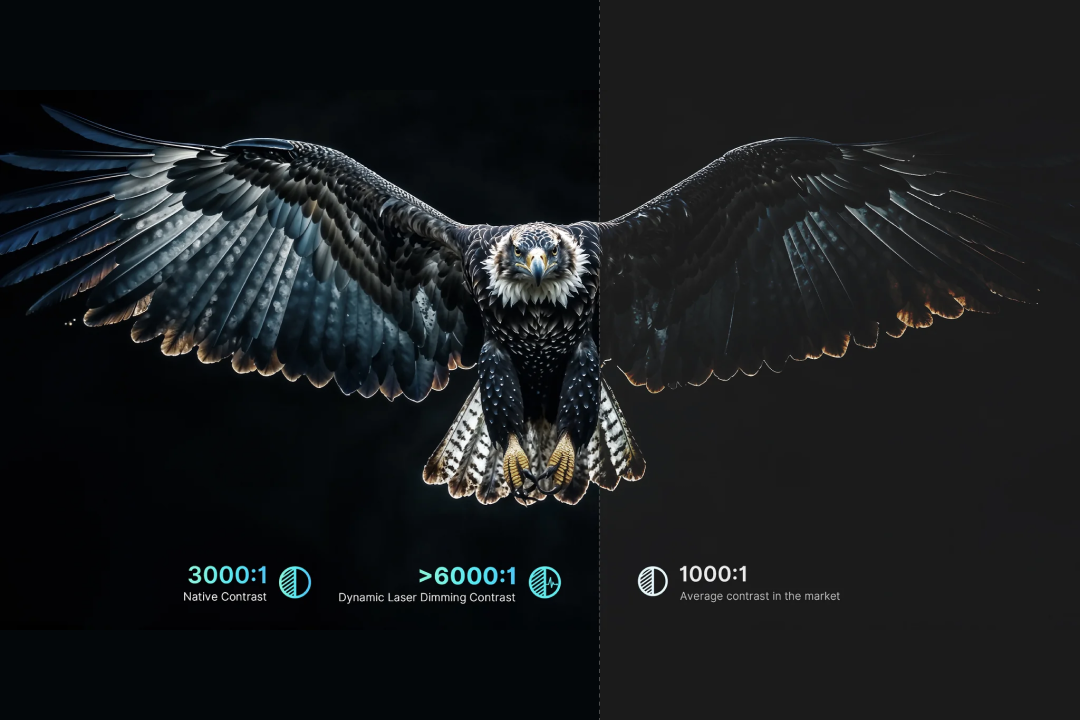
Brightness determines how much light reaches the screen, but contrast determines how much depth and detail you see.
A projector with excellent contrast often produces a more immersive image than a brighter projector with washed-out blacks.
For movie lovers, contrast can be just as important as brightness.
Color Accuracy
A bright projector doesn't necessarily produce realistic colors.
Accurate color reproduction makes skin tones look natural, preserves shadow detail, and creates a more lifelike image.
That's why professional reviews evaluate color performance alongside brightness, not separately.
Picture Mode
Many projectors achieve their maximum brightness only in a dedicated Bright Mode, which often sacrifices color accuracy for extra light output.
Professional reviewers frequently measure calibrated or usable brightness, or the brightness available while maintaining accurate colors.
For everyday viewing, this is often a more meaningful specification than peak brightness alone.
Your Viewing Environment
The same projector can perform very differently depending on where it's used.
- Dedicated home theater: Lower brightness is often sufficient because there's little ambient light.
- Living room: Moderate ambient light usually requires higher brightness.
- Daytime viewing: A brighter projector paired with an Ambient Light Rejecting (ALR) screen delivers the best results.
Choosing the right projector for your room is often more important than choosing between ANSI and ISO.
How Many Lumens Do You Need?
Once you've confirmed that a projector uses ANSI Lumens or ISO Lumens, there are several factors that have a much greater impact on your viewing experience. If you're still unsure about the ideal brightness setup for your space, be sure to check out our detailed guide, How Many ANSI Lumens Do You Really Need for a Home Theater?, to find the perfect match for your room.
| Viewing Environment | Recommended ANSI / ISO Lumens |
|---|---|
| Dark home theater (80–100") | 1,000–1,500 lumens |
| Dark home theater (120–150") | 1,500–2,200 lumens |
| Living room with moderate ambient light | 1,800–2,500 lumens |
| Bright living room | 2,500–3,500+ lumens |
| Classroom or office | 3,000–4,000+ lumens |
These are general recommendations, but they provide a useful starting point when choosing a projector.
How to Compare Projectors Fairly
When comparing projector brightness, keep these simple guidelines in mind:
✓ Compare ANSI Lumens and ISO Lumens with confidence. Both are standardized brightness measurements and are generally comparable.
✓ Ignore unofficial brightness claims. Terms like LED Lumens, Light Source Lumens, or simply Lumens without a recognized standard often use different measurement methods.
✓ Read independent reviews. Third-party testing provides valuable insight into real-world brightness and overall image quality.
✓ Look beyond brightness. Contrast, color accuracy, HDR performance, and your viewing environment all play a major role in how bright and immersive a projector appears.
Remember, the projector with the highest lumen rating isn't always the one that delivers the best viewing experience.
Conclusion
Although ANSI Lumens and ISO Lumens are defined by different organizations, they measure the same physical property (projected screen brightness) using very similar methods.
The biggest differences lie behind the scenes. ANSI focuses primarily on establishing a standardized brightness measurement, while ISO expands that framework with additional requirements for production consistency and international standardization.
For projector buyers, however, the practical difference is minimal.
If a projector is rated in either ANSI Lumens or ISO Lumens, you can generally compare its brightness with confidence. Rather than worrying about the label itself, focus on what truly affects your viewing experience: contrast, color accuracy, HDR performance, and choosing the right brightness for your room.
Ultimately, the best projector isn't the one with the most lumens; it's the one that delivers the best picture where you'll actually use it.
How to Compare Projectors Fairly
Aurora Pro: Precision Brightness, Perfectly Tuned
The Aurora Pro is designed around the idea that brightness should enhance realism, not overpower it. Its intelligently modulated light output delivers vivid images while preserving shadow detail and color depth in both dark and semi-lit rooms.
Who it’s for:
Home theater enthusiasts seeking a refined cinematic experience with balanced brightness, accurate color, and immersive sound.
Why it works:
Instead of pushing excessive brightness, the Aurora Pro focuses on tonal balance — ensuring highlights remain natural and blacks stay rich without eye strain.

- Stunning 4K with Dolby Vision for lifelike contrast and depth
- 6,000:1 Dynamic Contrast for deeper blacks and enhanced detail
- 107% BT.2020 Wide Color Gamut with △E≈1 color accuracy
- 60 W speakers with Dolby Atmos, plus HDMI eARC support for external audio
- 4K at 120 Hz Input and 4.2 ms~ 8 ms latency is ideal for gaming and high-definition content.
- Brightness tuned for comfort, not intensity
Aurora Pro MKII: Precision Brightness for Dedicated Home Theaters
Building on the Aurora Pro, the MKII introduces an upgraded Scene Adapt Engine (SAE) with finer real-time control over brightness and contrast. The result is smoother transitions between dark and bright scenes, more realistic shadow detail, and a picture that feels effortlessly natural.
Who it’s for:
Dedicated home theater users who demand reference-level contrast, precise brightness control, and true cinematic immersion.
Why it works:
With 2400 ANSI lumens, the Aurora Pro MKII sits squarely in the ideal home-theater brightness range: powerful enough for impact, yet restrained enough to preserve contrast integrity.

- Dynamic Contrast Ratio over 30,000:1 for true blacks and radiant highlights
- Next-Gen ALPD® 5.0 Laser Engine with Dolby Vision & HDR10+
- 2400 ANSI lumens optimized for cinematic viewing
- 0.21:1 Ultra Short Throw Ratio, ideal for smaller rooms and large screens
- 4K at 120 Hz Input and 4.2 ms~ 8 ms latency is ideal for gaming and high-definition content.
- 107% BT.2020 color gamut with △E≈1 accuracy
- 60 W Dolby Atmos speakers for immersive audio
TriVision Ultra: Balanced Brightness for Living Rooms
Operating at approximately 2600 ANSI lumens, the TriVision Ultra delivers vivid HDR-like performance while maintaining excellent contrast and color accuracy. Its brightness is carefully balanced to handle everyday ambient light without sacrificing cinematic depth.
Who it’s for:
Movie lovers who want authentic cinematic visuals in a living room environment, without the premium price tag.
Why it works:
By pairing moderate brightness with high color fidelity, the TriVision Ultra creates images that feel rich, natural, and immersive — even outside a dedicated theater room.

- Hybrid RGB Max Tri-LED-Laser technology for bright, speckle-free images
- 2600 ANSI lumens with 110% BT.2020 Wide Color Gamut
- Outstanding out-of-box color accuracy (△E<1)
- 4K with Dolby Vision and HDR10+ support
- Hybrid RGB Max Tri-LED-Laser technology for bright, speckle-free images
- Auto Screen Adaptation for fast, easy setup
- Hidden Fire TV Stick compartment (stick not included) for a clean installation
Frequently Asked Questions
Like what we do? Stay tuned for more.
Whether you work at home or in the office, NexiGo provides a wide range of quality and affordable technology to elevate your daily life. Our products encompass everything from webcams and portable monitors to projectors and gaming accessories.
Articles we think you'll love